BMI
Body Mass Index
What's your BMI?
Whenever weight loss and obesity are discussed, health experts always get around to talking about your numbers. There is your height, your weight, your blood pressure, your blood sugar, your cholesterol, etc. One number in particular that seems to be of interest is your Body Mass Index. This refers to a calculation that is used by health care providers to determine if a person is a reasonable weight for his or her height.
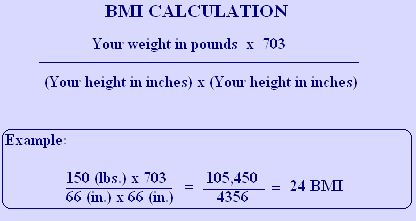
Here is the formula to determine your number:
Body Mass Index = [Your weight in pounds x 703] divided by [Your height in inches, squared].
See the graphic at the top of this page (purple background) for another way of showing this calculation.
Body Mass Index Tables
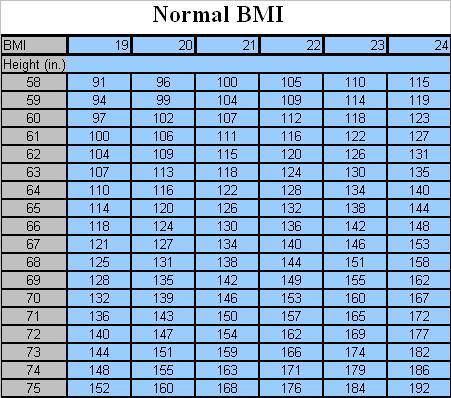
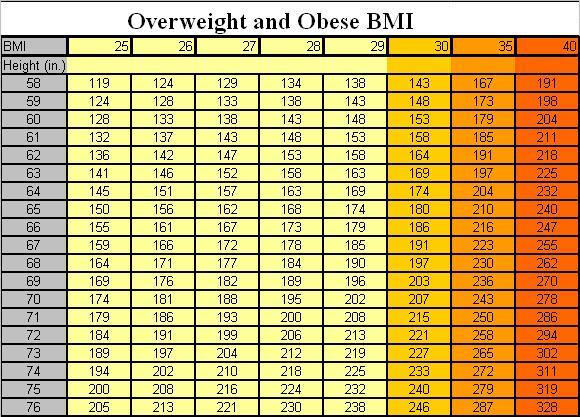
If you don't want to do the math, here are two tables--one normal and one high--that will help you determine your Body Mass Index. Just find your height in inches in the first column and then move across that row to your approximate weight and you will see your number at the top of the column that holds your weight.
Note: If you don't find your weight in the first table, move to the second table.
 |
 |
What the BMI number means
It is generally considered healthy to have a Body Mass Index between 18.5 and 24.9. If your number is below 18.5, you would be considered underweight and if your number is above 25 you are considered overweight. A Body Mass Index of 30 and above is considered obese, and a BMI above 40, morbidly obese.
What’s missing from the equation?
While knowing your BMI may be useful in a general sense, it does not take into account body composition, which is the proportion of fat, muscle, bone and other tissue in your body. Since muscle weighs more than fat, if you are an athlete with a lot of muscle and very little fat, your number may fall in the “obese” range, even though you are in great shape and not over fat at all.
In addition, this system does not allow for differences in bone size or density, which can factor into the issue of whether you are overweight for your height.
These differences in body composition explain why two people who are the same height and weight may look completely different. If one person has a lower body fat percentage, he or she will look slimmer than a person of the same height and weight with a higher percentage of fat.
The value of calculating your number
Having said that, there may be some real value in taking a moment to calculate your BodyMass Index, especially if you are not an athlete, since it can be a piece in the puzzle of your overall health picture. When you add in your other “numbers” such as blood pressure, blood sugar, triglycerides and cholesterol, along with what you know about your lifestyle, you will get a sum total of your prospect for health and longevity.
Of course, you are not a number but an individual person, and each person has to choose to eat healthier, be active and reduce stress in ways that are uniquely suited to the place where they live and work. Fortunately, there are many ways to accomplish these goals, and you can tailor a healthy lifestyle to suit your schedule and tastes. In this way, when you are reduced to your numbers, they will show a person with the ability to live long and well.
Click here to go from BMI page to Weight Loss page.
Most Recent Articles
-
Healthy Eating Information
Jun 13, 23 08:40 PM
 Healthy eating information to help you make food choices that will improve your chances to live long and feel well.
 -
Healthy Eating Habits
May 22, 23 12:20 PM
 A list of healthy eating habits that will help you live longer and feel better while you're here.
 -
Fasting to Lose Weight
May 08, 23 10:32 AM
A discussion of fasting to lose weight in all its various forms.