What is a Serving?
Small Step Toward a Healty Eating Lifestyle: |
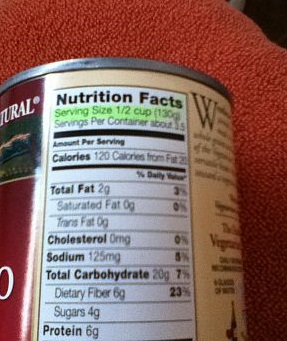
If you spend any time at all looking at healthy eating guidelines, you will come across the word “serving.” It is commonly recommended that you have 5-6 “servings” of fruits and vegetables each day. When speaking of protein, you may hear that you should include a “serving” of protein with each meal and snack. Food packages often shout in large letters that their product has only so many calories per “serving.”
However, if you don’t understand what the term serving refers to, all of this information will be useless to you. Is it bowlful? A plateful? Half a package? A whole package? The amount you are served at a restaurant? The contents of your fast food take-out bag?
What is a serving?
With regard to packaged foods, a serving is what the label says is a serving. You can check at the top of the nutrition label for “Serving Size” and you will find it given in ounces, grams, cups, Tablespoons, etc. This means that the amount of calories, fat and so on that are listed next on the label, apply to that amount of food.
Click here to for more information on Food Labels.
Useful for meal planning.
The other common use of the word serving in healthy eating guidelines is a somewhat arbitrary designation in which each food group is associated with an amount of food called a "serving."
The usual serving size for meat, fish and poultry is 3 oz.
If you have misplaced you food scale, the usual guideline for visualizing meat servings is that the portion should be the size of a standard deck of playing cards.
What is a Serving - For non-meat protein sources, a serving, is:
1 large egg,
1/2 cup cooked beans or rice, or
2 Tablespoons of seeds, nuts or nut butter,
and is equivalent to only about 1/3 of the protein in a serving of meat.
Tofu can also be included in this group with a serving size of about 4oz.
In addition, most health experts recommend that, whenever possible, choose a leaner or low-fat version of the significant protein sources, and to remove all visible fat from your meat.
The serving size for carbohydrates varies according to type.
For the Bread, Cereal, Rice and Pasta Group, a serving would be:
1 slice of bread,
1/2 cup cooked pasta, rice or cereal,
1 small roll, biscuit or muffin,
1/2 bagel or bun, or
3 small crackers.
As far as possible and for at least half of the time,if not all of the time, these servings should be made up of whole grains.
For vegetables, a serving would be:
1/2 cup cooked or raw,
1 cup leafy greens, or
1/2 cup vegetable juice.
Eat a variety of vegetables, with emphasis on the dark green, deep yellow, orange and red choices.
For fruits, a serving would be:
1 medium for most fruits,
1 melon slice,
1/2 grapefruit, or
1/2 cup berries, canned fruit or fruit juice.
Limit fruit juice and canned fruits in syrup, and eat a variety of fresh, whole fruits.

Don’t forget the dairy group.
A serving from the dairy group includes:
1 cup of milk or yogurt (generally low-fat or fat-free),
1 oz of hard cheese,
1/2 cup cottage cheese, or
1/2 cup ice cream or ice milk (occasionally).
Caveat for What is a Serving: In order to make their products sound better, some food companies have simply reduced the serving size. By doing this the food will seem lower in calories, fat and carbs, even though it is the exact same product as before. They can also achieve a “no trans-fats” status by making the serving size small enough to keep the trans-fat content below the limit set by the government for this designation.
Too much information?
This is a lot of information to absorb, but the small step that you can take to improve your diet is to pay attention to serving size. It may not be necessary to strictly measure every ounce of food, unless you tend to kid yourself about portions, but at least be aware of what a serving of food really looks like.
Fun Fact about What is a Serving: When you were a kid, a serving was the amount your mom put on your plate. You became aware of the concept at an early age, especially when she served you a food that you didn’t like!
Once you know what it looks like
Try to include one or more servings of fruits and vegetables with each meal and snack, with the emphasis on colorful vegetables. Add a serving of a protein food to that, and at least several times a day, include a serving of dairy and one of whole grains.
You’re not a kid anymore
Here in the U.S., we have gotten in the habit of letting others determine our serving sizes. When we were kids, it was our moms who did that, and as adults it’s the food companies, the restaurants, the fast-food places and even our friends and family. Of course, we have been only too willing to leave the decisions to others, but now is the time to decide for yourself which foods and how much food you will eat.
I hope you have a better understanding about what is a serving and that and that it will lead you to a healthier diet and lifestyle.
Eat and be healthy with my warmest regards,

Other Small Steps for a Large Reward?
Click on the links below to catch up.
Replace One Soft Drink at a time with a Healthy Beverage
Eat a Healthy Breakfast.
Click here to go from What is a Serving page to BMI page.
Most Recent Articles
-
Healthy Eating Information
Jun 13, 23 08:40 PM
 Healthy eating information to help you make food choices that will improve your chances to live long and feel well.
 -
Healthy Eating Habits
May 22, 23 12:20 PM
 A list of healthy eating habits that will help you live longer and feel better while you're here.
 -
Fasting to Lose Weight
May 08, 23 10:32 AM
A discussion of fasting to lose weight in all its various forms.