Magnesium Sources and Functions

Magnesium Sources and Functions
All of the nutrient minerals work together to keep you healthy and feeling good. Here is a summary of the role of magnesium, a major mineral, in your good health.
Mineral multi-tasking
Magnesium is found mostly in the bones and muscles of your body. It is very important in so many ways and consequently, if you don’t get enough magnesium in your diet, you will not feel well.
In addition to helping to maintain bone and teeth health, magnesium is a catalyst in building protein and producing energy. When your levels are low, you will feel weak and dizzy.
Magnesium is also involved with muscle contraction, and the transmission of nerve impulses.
It is necessary for healthy heart function and normal blood pressure. It also helps you to stay healthy by supporting your immune system.
| What it does | Maintain bone and teeth health; energy metabolism; protein formation; normal nerve and muscle function; enzyme activity; healthy immune system |
| Daily needs | [Infants: 30-75 mg] [Children: 80-410 mg] [Men: 400-420 mg] [Women: 310-320 mg] [Pregnant: 350-400 mg] [Lactating: 310-360 mg] |
| Not enough | Weakness, confusion Severe: Children: Failure to grow; Adults: Hallucinations, convulsions |
| Too Much | Dehydration from diarrhea |
| Foods | Dark green leafy vegetables, whole grains, nuts, legumes, seafood, some fruits, bran |
*The lower value is for infants up to 6 mos.,higher value is for infants up to a year old.
† The first value is for children 1-3 with the amount increasing until age 18.
Many good magnesium foods
Magnesium is found in a variety of foods, including the following:
Fish… Almonds… Cashews… Peanuts… Peanut butter… Watermelon… Broccoli… Tofu… Sunflower seeds… Spinach… Molasses… Tomato juice… Artichoke… Okra… Brown rice… Pinto beans… Whole wheat bread… Hard water… Low-fat milk… Green leafy vegetables
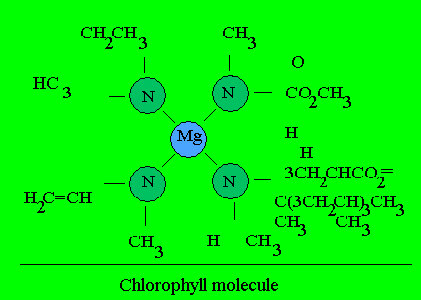
Fun Fact about Magnesium Sources and Functions: As you can see from this diagram, Magnesium (Mg) forms part of the chlorophyll molecule (That’s what makes plants green!). When you eat green plants, especially dark leafy ones, you are eating chlorophyll, and thus, magnesium! This is just one more reason to include lots of salads and other dishes that focus on vegetables in your menu plans!
Am I getting enough?
Health experts generally believe that most people do not get enough magnesium in there diets. However, actual magnesium deficiency is rare. It is possible that the magnesium in the water supply makes up for the deficit in the diet. Hard water in particular is generally higher in magnesium content. It has been found that in populations where hard water is regularly consumed, there is a decrease incidence of heart problems.
--Caveat: If you have diabetes, overuse alcohol, or take diuretics, you may be prone to magnesium deficiency. This is most likely because the magnesium is being excreted due to the excessive urination associated with these issues.
Can you get too much?
Too much magnesium in the form of supplements can kill you, so be careful of the dose, if you choose to take a magnesium supplement. There is no evidence that magnesium toxicity can result from food sources.
The Upper Limit that has been established for adults for magnesium is 350 mg, but only applies to non-food sources of this mineral.
Click here to go from Healthy Eating Minerals - Magnesium Sources page to Healthy Eating Minerals page.
Most Recent Articles
-
Healthy Eating Information
Jun 13, 23 08:40 PM
 Healthy eating information to help you make food choices that will improve your chances to live long and feel well.
 -
Healthy Eating Habits
May 22, 23 12:20 PM
 A list of healthy eating habits that will help you live longer and feel better while you're here.
 -
Fasting to Lose Weight
May 08, 23 10:32 AM
A discussion of fasting to lose weight in all its various forms.