Food Pyramid
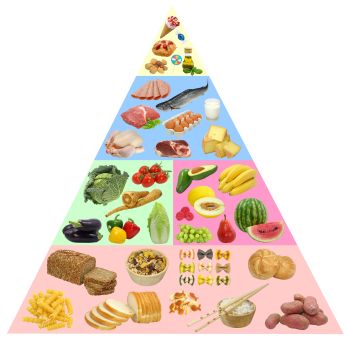
The Food Pyramid is a visual representation of the five food groups and the proportional amounts of each that we should eat on a daily basis. It may be found in different forms, but in one version, the broad base of the pyramid is made up of the Bread, Cereal, Rice and Pasta Group, the group from which, according to this theory, we should get the most servings, while the tip of the pyramid is the Fats, Oils and Sweets Group, from which we should get the least servings. The Dairy/Protein and Fruit and Vegetable Groups show up in the middle of the pyramid.
Planning your diet
The Food Pyramid is a useful tool for planning a healthy eating lifestyle. The goal of all healthy eating plans should be (1)to eat a variety of fresh, whole foods, with a focus on fruits, vegetables, whole grains, lean proteins, and healthy fats, (2)to eat all foods in moderate amounts, and (3)to limit foods that have no real nutritional value.
It is my hope that in the pursuit of good nutrition and a healthy eating lifestyle, you will discover some new and delicious foods that will enhance your meals and give you the energy and wellness to live the life you want.
Another version of the pyramid, designed by the USDA, divides food into Grains, Vegetables, Fruits, Dairy, Meat/Beans and Oils. In this depiction, the pyramid is divided vertically into these six groups with Grains taking the largest slice, followed by Vegetables, Dairy, and Fruits, then by Meat/Beans, with a small sliver designated for Oils.
Out with the old!
After twenty years, the USDA has changed their visual representation for eating healthy from a pyramid to a simpler concept called "MyPlate." This newer model shows a dinner plate divided into four portions for Protein, Vegetables, Fruits and Grains, with a side of Dairy.
For more information on the USDA My Plate, you can visit the USDA website using the following link:
A picture of your diet
Regardless of the form it takes, the idea of the pyramid is for you to be able to see a picture of how you are eating. Without being too precise, if you are generally eating more complex carbs--whole grains, fruits and vegetables--than you are the other foods, and if you are limiting your intake of fats and added sugar, you are probably doing okay.
Unfortunately, for many of us, our pyramid is top-heavy. This means that we are getting many or most of our calories from fats and sweets, which has contributed to the rise of obesity and adult-onset (Type II) diabetes in this country. It also may have contributed to the increase in heart disease and some forms of cancer. Fortunately, we can reverse this trend by simply being more aware of what we eat.
Anti-Inflammatory Pyramid
Dr. Andrew Weil, a Harvard-trained physician (and botanist), and a proponent of Integrative Medicine, has put a new twist on the concept of the pyramid. Since inflammation seems to be at the basis of most disease, eating an anti-inflammatory diet may help prevent health problems. To that end, Dr. Weil has developed his "Anti-Inflammatory Food Pyramid."
You can find out more by visiting his website at http://www.drweil.com.
Click here to go from Food Pyramid page to What is a Serving page.
Most Recent Articles
-
Healthy Eating Information
Jun 13, 23 08:40 PM
 Healthy eating information to help you make food choices that will improve your chances to live long and feel well.
 -
Healthy Eating Habits
May 22, 23 12:20 PM
 A list of healthy eating habits that will help you live longer and feel better while you're here.
 -
Fasting to Lose Weight
May 08, 23 10:32 AM
A discussion of fasting to lose weight in all its various forms.