Recipe Baklava
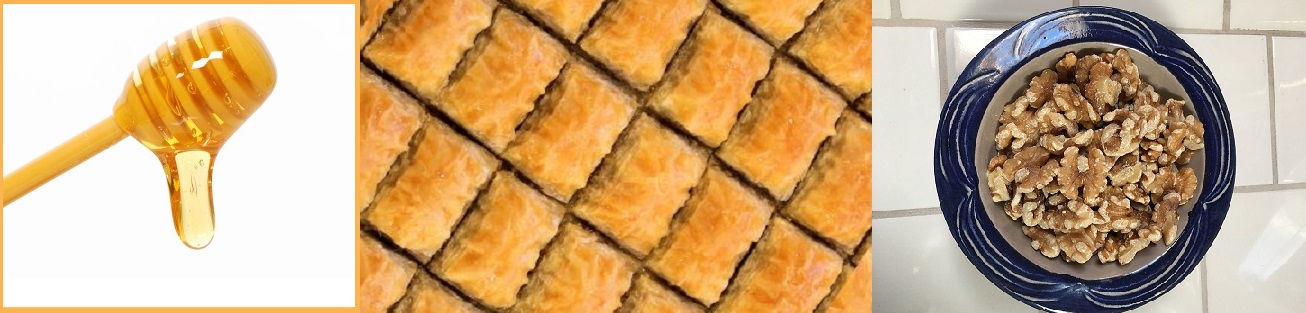
Recipe Baklava
Click here for a printable copy of this recipe.
4 cups nuts (choose one of these: walnuts, pistachios, pecans)
1 tsp cinnamon
1 pound phyllo sheets (found in freezer section near piecrust)
1 cup butter, melted
1 and 1/2 cups honey, warmed in pan on stove (do not boil)
Equipment you will need for Recipe Baklava
Hand-crank nut grinder
9x13 baking pan
Pastry brush
Clean, damp dishtowel
Sharp knife
Preheat oven to 300 degrees.
Instructions:
(1) Thaw frozen phyllo leaves in refrigerator overnight or on the counter for several hours.
(2) Heat butter until just melted.
(3) Grind walnuts into a course meal and add cinnamon. (For best results, use a hand grinder, so there are pieces of walnut visible.)
(4) If phyllo leaves are larger than your pan, cut to fit, saving scraps for use also. Flatten out phyllo leaves on paper and cover with damp dishtowel to keep them from drying out.
(5) Using a pastry brush, brush bottom of 9x13 pan with butter, and place one phyllo sheet to cover bottom of pan. Brush with butter (just enough to cover) and add another sheet. Repeat this procedure until you have six phyllo sheets, brushed with butter, in the pan. Add about ¼ of the nut mixture and spread evenly.
(6) Top with six more phyllo sheets brushed with butter.
(7) Repeat this process until you have used all of the nut mixture. (If you had to trim the sheets, use several scrap pieces to form a layer.)
(8) Take remaining phyllo sheets, as a stack, and place over last nut layer. Pour remaining butter over sheets.
(9) Using a sharp knife, cut into 12 squares and then diagonally across each square, being sure to cut only 3/4 of the way through the layers.
(10) Bake for 1-1/2 hours until golden brown.
(11) After removing from oven, pour warmed honey over the top, allowing it to drizzle down through the cut lines of the baklava.
(12) Cool and cut the rest of the way through the cut lines into triangles. May be stored in cool dry place for several weeks.
Notes for Recipe Baklava
-Don’t be too fussy about the layers of phyllo; if the sheet rips or is in pieces; just place the pieces in the pan to form a layer and brush with butter.
-You can keep the thawed phyllo in the refrigerator for up to a month.

-Keep the damp dishtowel on the unused phyllo sheets except when you are actually placing the sheets. If you work fast, you don’t have to replace the towel after each sheet, but you should cover the unused sheets when adding the nut mixture. If you get interrupted in the middle of the process, be sure to cover the unused sheets and also, that the sheets in the pan are covered with butter.
-If you had to trim the sheets to fit your pan, use the trimmings (several pieces at a time) to form layers in the middle of your baklava. This way the top layers and bottom layers will be a whole sheet and the pieced sheets will be in the middle where they are not noticeable.
-On this page is a diagram of how to cut (partially through the layers).
Fun Fact for Recipe Baklava: Some ambitious bakers may make the phyllo sheets from scratch. This may require a large surface to roll out the dough into paper-thin sheets.
Click here to go from Recipe Baklava to Nuts and Seeds page.
Most Recent Articles
-
Healthy Eating Information
Jun 13, 23 08:40 PM
 Healthy eating information to help you make food choices that will improve your chances to live long and feel well.
 -
Healthy Eating Habits
May 22, 23 12:20 PM
 A list of healthy eating habits that will help you live longer and feel better while you're here.
 -
Fasting to Lose Weight
May 08, 23 10:32 AM
A discussion of fasting to lose weight in all its various forms.